Showing posts with label Venice. Show all posts

Monday, March 18, 2019

On the Road in Italy (part 4)


Our last morning in Florence was spent at the same little sidewalk café where we had spent every morning in Florence, starting the day with a pastry and the finest cappuccino. It was just around the corner from our hotel. Across the way reared the Santa Maria Maggiore church, the oldest in the city. It was early and the streets were quiet, lending to a peaceful atmosphere to spread the road map out on the table and plan our day. We were at that wistful point of the trip where all that remained was the final leg of the journey. For two weeks we had been in Italy, and only four days remained before we flew home. It had been mostly go-go-go. But now we would be slowing it down. Heading for the Tuscan hills, we were. Chianti... Wine... Medieval villages... And to celebrate Terry’s birthday.  
~~~~~~~


Lost in the Tuscan Hills

“This can’t be right,” emitted Terry, both hands gripping the wheel as she maneuvered around another deep rut.

I had to agree with her. The skinny dirt road that we were driving up was getting steeper and more rugged by the minute. But still… I was pretty sure we hadn’t made a wrong turn—until the underside of our Audi scraped over a big rock. 

The drive south from Florence had been incredibly picturesque, the highway wandering through rolling hills of vineyards and olive groves, past wineries and farm houses and the occasional village. After twenty miles, at the town of Greve in Chianti, we turned onto a country lane that snaked up into wooded hills, gaining a thousand feet of elevation and passing a few more vineyards along the way. We had come close to five miles up this road when I spotted the tiny sign that I’d been looking for: Lionforti da Vico. Lionforti would be our lodging for the next three nights, while Vico was the old Tuscan settlement where it was located. Terry turned onto the dirt road at the sign, and we followed it up the hill and into the woods for a mile or more. Then the road got steep and gnarly. And then we scraped bottom. Yes, this couldn’t be right. Could it?

At the top of the grade was a lone farm house. Terry braked to a stop and I got out to see if anyone was home. A woman came out of the house as I approached the front door.

“Sto cercando Lionforti,” I explained.

The woman nodded, and then quickly rattled off directions in Italian that I interpreted roughly to mean that we had missed a fork in the road about a kilometer back. She pointed to the forested mountainside about a mile away, where we'd find what we were looking for—or at least that’s what I think she indicated.

Indeed, following the other dirt road, we came upon the settlement of Vico, which consisted of four or five 14th-century stone houses and a tiny chapel that looked even older. If Michelangelo himself would’ve come riding by on a mule, he wouldn’t have looked out of place.

The Lionforti was the first house we came to, and the innkeeper/owners, Salvatore and Silvia, graciously got us settled into our room. The back yard overlooked the valley and had a swimming pool. After the hustle and bustle of Florence, the quiet solitude of the mountainside was welcoming. Sunrises and sunsets were both resplendent. One evening, we sat on the back patio and listened to crickets, sharing a bottle of wine and munching on bread and cheese. That was dinner. The pace of life was slowing down. What else does one need? When in Tuscany…

The road to Vico.

Lionforti da Vico

Hanging out in the back yard.  

Tuscan serenity


Greve in Chianti

The nearest town to our lodging at Lionforti was Greve-in-Chianti, twenty minutes down the hill. It’s a quaint little town, smack dab in the middle of the Chianti wine region where they’ve been making vino for at least seven hundred years. The countryside looks like our Napa or Sonoma (in fact, Greve’s official sister city is Sonoma). In addition to wine, high-quality meats, including wild game, are a specialty of Greve. The family-run Macelleria Falorni is the oldest butcher shop in Italy (over 200 years!) and it's still doing good business in the old town square. And then there’s the incredible cycling going on all over Chianti. A bicycle, a little wine and salami, and you’re good to go. Cin-cin!

During the day, it’s a placid town. But things liven up in the evening when the tourists and cyclists descend on the restaurants for grub. For Terry’s birthday, we dined at the swish Fuoripiazza, which means “out on the square.” Which is where we were seated: outside on the plaza square under a sunset sky. Our waiter even surprised her with an ornate dessert with a candle on top. (Honest honey, I have no idea how they knew.)

Chianti

Greve in Chianti

Wild boar in front of the Macelleria Falorni, the oldest butcher shop in Italy.


The Towers of San Gimignano

The medieval town of San Gimignano was on our list to see, though getting there from our hillside redoubt above Greve was somewhat circuitous. This is because the furrowed Tuscan valleys mostly trend north to south, and roads going east-west thus cut against the grain—and San Gimignano was three valleys east of us. First, we took the road down to Greve and crossed the river, then climbed over a ridge and descended to the Pesa River, and then up and over a pass to the Elsa River. But the scenery was gorgeous, so what's the rush?

Rounding a bend in the road, we recognized San Gimignano at first sight, standing apart on a high hill, its stone towers piercing the sky. People have been living on this hill for over two thousand years, going way back to the Etruscans. Feudal walls encircle the old village where castle towers abound. By the 14th century, there were seventy-two towers gracing the skyline, but only fourteen remain today. The town is also one of the way stations for the Via Francigena, which is part of the old pilgrimage route that runs from Canterbury, England to Rome. Used extensively by Christian pilgrims in the Middle Ages, it has become popular with trekkers today.

We spent a few hours wandering the streets and passageways of San Gimignano, soaking up its Romanesque and Gothic charm. We had lunch and Aperol spritzes at a café on the main plaza, relaxing in the shade of an old tower. Then, more exploring. At the south end of town is the Museum of Torture—aptly, downstairs in a dungeon—and out of morbid curiosity, we dropped in. It was very authentic and unsettling. We didn’t stay long. But hey, the gelato shop in the plaza was awesome.

San Gimignano

The furthest tower in the back is Torre Rognosa. Erected in 1200, it is the oldest tower still standing. It’s 167 feet tall, the second highest in town.      

Piazza Della Cisterna: the town's plaza center, where the public well and cistern in the middle dates back to the 13th century.  

Gothic arches  

Inside the 12th-century Basilica of San Gimignano.
The church looks quite ordinary on the outside, but
the interior is rich with early Gothic architecture
and frescoes.

Virgin Mary Shrine in the Basilica of San Gimignano.

A medieval suit of armor stands guard at the entrance to the Museum of Torture. 


Amerigo's House

It was our last day in Chianti, and the plan was to check out the wine museum in Greve. We wanted to see first hand how they made Chianti the old-fashioned way—or at least that’s what the brochure promised. The thought of squishing grapes with my bare feet sounded primitive and enticing, and we were down at the museum at ten o’clock sharp for the tour, ready for some squishing, as were a few other people. The front doors were locked, so we loitered outside. Twenty minutes passed. Nothing. Finally, one of the other couples waiting for the tour ducked into the adjacent smoke shop and asked if they knew anything. The shopkeeper made a phone call. Turned out, the wine-making tour and demonstration had been canceled!

Now what? Ter and I trudged up a steep side road to the edge of town and sat in the heaven-sent shade of an oak tree. It was already getting hot—too late for a bike ride—and my enthusiasm was flagging. I reclined in the dry grass and closed my eyes while Terry searched for a Plan B on her phone.

“There’s a small village up the hill from here,” she said. “We could check it out.”

Hm.

“There’s an old church there… A restaurant... It’s not too far, we could walk it.”

Hm.

“Hey, listen to this: The house of Amerigo Vespucci is there.”

Huh? What?

Okay, now she had my attention. Without further ado, we plodded up the country lane for about a mile, past timeworn olive groves, to the top of the hill where the walled hamlet of Montefioralle crowned the summit. The initial church and castle houses were built in the 11th century, long before Greve existed. Most of the surrounding land at the time was divided among four prominent families—one of them being the Vespucci family. They were a well-to-do clan; part of the “in crowd” of cosmopolitan Florence. Many contend that Amerigo was born in Montefioralle, though historical accounts show that he was later raised and schooled in Florence. In 1492, he was commissioned by a Medici merchant company to go to Spain and look after their business interests. That was right when Christopher Columbus was discovering a bunch of islands and half-naked people on the other side of the pond. This would pique Amerigo’s interest in exploration and cartography, and in a few years, he too was venturing overseas, becoming the first to use the term “New World” in documents, and claim that a fourth continent existed west of Europe and Africa, and it wasn’t a part of Asia. Master cartographer, Martin Waldseemüller, agreed with him. His updated 1507 map of the world would show this yet-indistinct, murky continent, and he would label it “America” after Vespucci. The rest is history. 

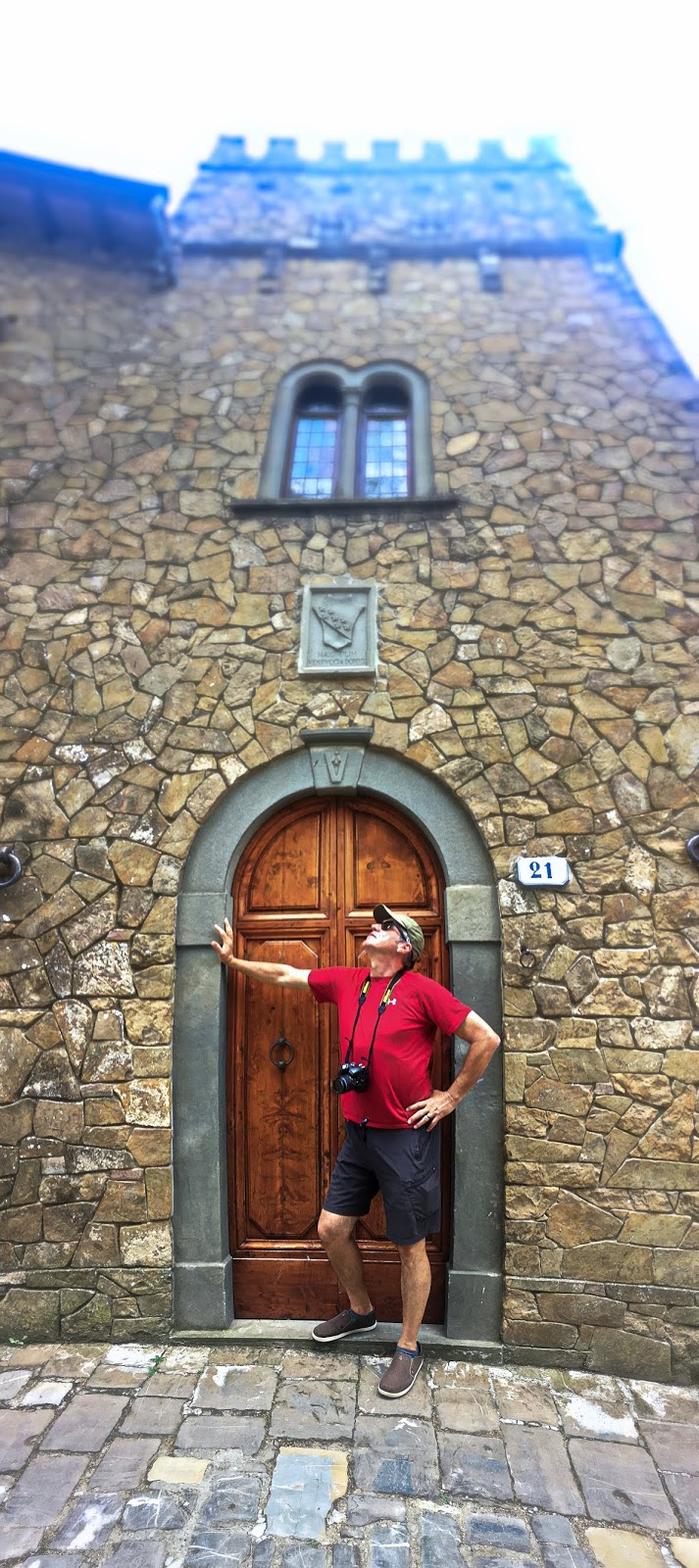
You can’t beat the view from a hilltop medieval castle village, and Montefioralle is a prime example. We lost ourselves in the solitude of cobbled streets that were not much wider than an ox cart. The village is small. Quiet. There are no hotels. No gift shops. If you get hungry, there are three quaint restaurants to choose from. Indeed, the longer we lingered, the more we liked the place. In due course, we did locate the Vespucci ancestral country home where Amerigo was supposedly born. Above the doorway, a stone plaque in the wall is engraved with the family coat of arms: a shield with a banner of wasps (the Vespucci surname is derived from “vespa,” which is wasp in Italian and Latin). Should I knock? Nobody seemed to be home. The address is 21 Castle Way. If you ever get to Montefioralle, rap on the door. If anyone answers… Ask ‘em if Amerigo is home. 

A view of Greve from outside the walls of Montefioralle.

The streets of Montefioralle.

Hitch your horse here. And pick up your horse poop.

Lost. In a good way.  

Lunch with a view.

Amerigo Vespucci

The Vespucci residence.

The Vespucci  house cat?


Ritorno a Venezia

“How sweet the moonlight sleeps upon this bank! 
Here will we sit and let the sounds of music creep in our ears.”   
         —William Shakespeare, The Merchant of Venice.

Inevitably, all good journeys come to an end. We packed and departed Greve in Chianti after breakfast, heading north with Tuscany in the rearview mirror. Three hours later we were dropping the car off at Marco Polo Airport, and then catching the water bus out to Venice—where it had all started. It was our last night in Italy. We sprung for a suite on the Grand Canal.

After spending three days in Venice on the front end of the trip, it didn’t take long to get our bearings again. We wandered the San Marco borough; browsed through the shops one last time; found a romantic, out-of-the-way restaurant for dinner. Then we joined the throng in Saint Mark’s Square at sundown, pigeons wheeling overhead as the voice of a woman singing opera drifted across the plaza and the day succumbed to the night.

La fine.


The view from our hotel.


Drinks in Saint Mark's Square. Cin-cin!

A little opera for ambiance.

Sundown in Saint Mark's Square.
  
~~~~~~~~~~~~~


Trip Summary...


THE JOURNEY 
We logged 890 miles on the Audi. Though we didn’t need a car in Venice (no streets!), and it was parked the whole time we were in Florence, it was definitely handy everywhere else along the way. Terry loved the car. It had cup holders. 


THE ETHOS      
The Italians call it “La Vita Bella”—the beautiful life. And they don’t mean a “luxurious life”, but rather a relaxed, family-centric lifestyle that puts quality over quantity. There is no such thing as Italian fast food: their culture transcends “quick and cheap.” Meals are eaten unhurried. At restaurants, food servers won’t bring your bill until you signal for it—dropping it off before you ask is considered rude. Italians love their vino and can be the zest of the party—but over-drinking in public is considered boorish. And they don't rush around clutching a to-go cup of coffee: they relax and sip their espresso at a coffee bar or bistro table. There is much more emphasis on how time is spent rather than being on time. Family is everything and extended-family dinners on Sundays are common.

THE FOOD   
Italian cuisine is the bomb. That is all. 

Yes, I know what you’re thinking: What about all that fancy French food? Well, it came from Italy. Remember Catherine de’ Medici, the girl from Florence who married the French prince and later became Queen of France? She was appalled with the mundane food of French royalty and their habit of eating with their fingers, so she brought her own chefs to Paris—including Ruggeri and his top-secret ice cream—and transformed their abysmal diet into what we know as French cuisine today. Also, she introduced them to the dinner fork. No more fingers. But back to Italy: If I had to pick some meals from the trip that stood out above the rest, they would be the beet ravioli at the Lagazuoi Rifugio; the lasagna in Cortina d’Ampezzo; and the roasted wild boar in Canazei. They were incredible. Oh, and pizzas were popular everywhere and they were all good.      

THE TOAST       
One night, a waiter poured our wine and said “Cin-cin!” when he was done. It sounded like he had said “ching-ching”, like the sound of two glasses clinking together in a toast. Later I discovered that it means “To your health,” similar to “salute” or “cheers” or “tally-ho” or whatever. Cin-cin. I like the ring of it.  

BREWS & LIBATIONS
Beer-drinking seemed to be more prevalent in the mountain towns, though we didn’t sample many. Pale lagers such as Peroni are popular. My favorite was a Moretti La Rossa (red ale?). Down in the warmer climes of Venice and Tuscany, there were a couple of summer drinks that are uber-popular with both locals and tourists. One is the neon-orange Aperol spritz, made from Aperol (a citrus/rhubarb liqueur), Prosecco (an Italian white wine), and soda water. The other is the Negroni, made with sweet vermouth rose, gin, and Campari (a liqueur of fruits, herbs and spices). If these drinks aren’t your thing, there is always plenty of Chianti wine. As I said earlier, the Italians love their vino—and they drink more of it per-capita than the French.  

Cin-cin! 


Navigation to...

PART ONE      PART TWO      PART THREE


Friday, February 22, 2019

On the Road in Italy (part 1)


Terry and I touched down at Marco Polo Airport late in the morning, the dome of the sky a marbled creation of resplendent sunlight and misty clouds. Once through customs, we followed the signs to the swift-moving walkways that would deliver us to the water transport terminal. The airport is on the mainland, but our destination was three miles off shore, glinting on the horizon: Venice. We were embarking on an eighteen-day tour of northern Italy that would begin and end in this city. In between, we would venture high into the Dolomites, and then descend upon sun-drenched Tuscany, the cradle of the Renaissance, where one can sit under a hillside olive tree all afternoon and watch clouds drift across the sky and not feel that the day was wasted. Our plan was to take it slow and easy; bask in the vibe that is Italy. La vita bella! 

Aboard the water bus, we plied across the Venetian Lagoon and watched the city grow on the horizon. Bell towers, cathedral domes, columned facades, all built of weathered stone and brick, gradually consumed the cabin windows. There was not a speck of bare ground to be seen anywhere, not even a small hill. The city literally appeared to rise from the water and float upon its surface. 
 
San Marco was our stop. We wheeled our luggage off the water bus into a swarm of people, enraptured by the sights and sounds of another world. Through a labyrinth of colossal buildings and crowded plazas we wandered, searching for our hotel with map in hand. It was supposed to be a “600-meter walk” from the bus stop, only we strayed off course more than once. Sometimes an avenue’s name is painted on the corner of a building. But most times, it’s not. Welcome to Venice. The adventure begins.
~~~~~~~


Venezia

The Hotel Al Gazzettino where we were staying is right in the middle of the San Marco borough: a five-minute walk to the Rialto Bridge in one direction, and a five-minute walk to Saint Mark’s Square in the other direction. We had three days to explore the city—and in retrospect, that wasn’t enough time. But we made the best of it.

The founding of Venice goes back fifteen centuries to the collapse of the Roman Empire, when the region suffered from Germanic and Hun invasions. Its name is derived from the Veneti people who settled in the marshy lagoon islands to better defend themselves against marauders. Unlike most feudal realms of the Middle Ages, the Venetians gained their wealth and power not by owning large parcels of land that were worked by throngs of serfs, but rather by securing lucrative trade routes: silk from China; spices from the Indies; gems from Egypt. They would become the virtuoso merchants, presiding over most of the commerce to and from distant lands and making Venice the first international market hub in Europe.

Ocean routes established by Portugal and Spain to the Far East in the 16th century severed Venice’s trade monopolies to those lands. But always the savvy merchant, the Venetians leveraged their wealth to expand commerce in other directions. This acquired wealth shows in the old palatial homes, government buildings, music halls, and cathedrals of yesteryear. It was a city-state republic for nearly a millennium—from the 8th century, to its surrender to Napoleon Bonaparte in 1797. The Renaissance artwork of Bellini and Titian (both natives of Venice) adorn the Doge’s Palace and several churches, and the pitch-perfect notes of opera and the music of Vivaldi still waft across the Piazza. Walking the streets here is indeed like walking through time.

Church of San Giorgio Maggiore. Completed in 1610.
Designed by Andrea Palladio, one of the most influential
architects from the Renaissance era.

Greek warrior, Saint Theodore, stands atop one of the two Pillars of Justice. The two giant columns were pilfered from the Holy Land in the 12th century and erected here at the main entrance into Saint Mark’s Square. Public executions and punishments were carried out at the base of the columns during the Middle Ages. The building at right is the colossal Saint Mark’s Library, completed in 1553.     

Saint Mark’s Square. Known to Venetians as Piazza San 
Marco, or simply the Piazza, it's the eternal heart and soul 
of the city. At the far end is Saint Mark’s Basilica. The 
323-foot tall bell tower is a replica of the 16th-century 
original that collapsed in 1902. 

Another view into Piazza San Marco. 

Venus and the winged lion of Saint Mark at the base of the statue of Victor Emanuel II, first king of a united Italy. Venice joined the new nation in 1866 after seventy years under French and Austrian rule. 

Hiding from the Paparazzi.

Sangiovese and summer showers.

A quiet neighborhood.

Early evening on the Grand Canal.

Lost in the Castello borough.


Water World

Soon after reserving our rental car for the trip, I had emailed our Venice hotel to inquire about guest parking accommodations. Their reply—which no doubt came after a bout of hysterical laughter—was quite simply: “DON’T BRING CAR. NO STREETS!”

How did this detail get by me?

Venice is built on a cluster of 118 small islands that are not much higher than high tide, linked together by a network of 150 canals and over 400 footbridges. To keep the buildings from settling into the marshy ground, even the giant Saint Mark’s Basilica, millions of wood pilings were driven vertically into the mud (by hand!) to form a solid foundation—an engineering marvel when you consider how long ago it was done.

Hence there are only two modes of travel in this city: by foot, or by boat. Water buses run on regular schedules around the islands and along the Grand Canal. There are also water taxis for hire (but they’re not cheap). Many residents own a motorboat of some sort, which they tie up in front of their home, or keep in a boathouse underneath the home. And then, of course, there’s the iconic gondolas, which are mostly used now to pole tourists around. Need an ambulance? It’s a speedboat with a siren and flashing lights. Police? Same thing. Garbage is collected and taken away by boat. Your Amazon Prime delivery comes to you via boat, as does all the merchandise that you buy in town. The canals have a speed limit and the cops use radar guns to enforce it. And what’s in the fire station? You guessed it.

Morning "work traffic" on a side canal. Vessel at right foreground is city police.    

Private powerboat on the Grand Canal. 

A 1732 painting by Venetian artist, Canaletti, portrays the Ascension Day Regatta on the Grand Canal, a festive event that is still held today.  

Delivering a refrigerator.

GONDOLA FACTIODS
~ They go back to the beginning of Venice. 
~ Contemporary ones are eleven meters long, 
made of 280 hand-crafted parts using seven different
types of hardwood. 
~ Only three boatyards remain that still build them. 
~ A new one today will set you back $40,000. 
~ They are all painted black per a Great Council 
decree dating back to 1609. Black was considered the 
color of elegance.  
~ There were around 10,000 gondolas in Venice in
the 16th century. Now there are only 350. 
~ The gondolier’s profession is controlled by a guild, 
which issues a limited number of licenses (approx 400), 
granted after rigorous training and apprenticeship, 
and upon passing a comprehensive exam which tests 
knowledge of Venetian history, landmarks, foreign 
languages, and adept skills in handling a gondola. 
~ In 2010, Giorgia Boscolo became the first fully-licensed 
female gondolier. (It took how many centuries?) 
~ A good gondolier today can make $150k a year.


Empire

According to Forrest Gump, “Life is like a box of chocolates: you never know what you’re gonna get." In that respect, wandering the cobbled lanes of Venice was sometimes like a box of chocolates—you never knew where you might end up next. We roamed the San Marco and Castello boroughs one day, from the crush of the Piazza San Marco to the tranquil, off-the-beaten-path nooks in Castello—which is how we stumbled upon the San Lorenzo Church where Marco Polo is buried. Then again, not everything we did was random. Here are three of them…

MUSEO STORICO NAVALE    
In the year 1204, Venice allied with the Franks for the Fourth Crusade with the intent of taking back Jerusalem from the Muslims—only they didn’t quite reach the Holy Land, and sacked the Byzantine Christian capital of Constantinople instead. The Venetians, who had the most formidable navy in the Mediterranean throughout the 13th and 14th centuries, built the entire war fleet for this endeavor in the fortified Arsenal shipyard behind the Naval Historical Museum. The Arsenal was the largest factory complex in Europe before the Industrial Revolution, employing 16,000 Venetians at its peak. Today the 110-acre site is an Italian navy station, closed to the public except for the buildings that house the museum. Plenty of maritime exhibits to be seen here, from scale models of medieval war galleys to full-size restorations of various boats.   

Entrance to the Arsenal. 

Bragozzo fishing boat: a Venetian shallow-draft design that goes back 600 years. 

The winged lion of Saint Mark at the bow of the Royal
Barge used by King Emmanuel II in 1866 when Venice
joined the Kingdom of Italy. 
   
Guilded engravings on the Royal Barge.


SAN MARCO BASILICA
In the 9th century, two Venetian merchants in Egypt absconded with the mummified remains of Mark the Evangelist and spirited him away to Venice, where he was to be entombed under a grand cathedral that had yet to be built. Saint Mark’s Basilica was completed in 1094, though additions and enhancements would continue for centuries. The opulent Byzantine domes and spires are a sight to behold. Inside, the entire ceiling of the vaulted nave is adorned with detailed mosaics on a background of gold tiles. One can also venture down to the crypts and behold Saint Mark’s tomb. It rests directly below the main church alter on the floor above. Impressive.    


The saga of the Horses of Saint Mark is a lengthy one. There are four total, cast from copper in the 2nd or 3rd century, probably in Rome. But by the 5th century, they had found a new home at the Hippodrome in Constantinople, where they would grace the race track there for 800 years—until the city was sacked during the 4th Crusade and the Venetians snatched the horses for booty. They were shipped to Venice and placed here over the entrance to the Basilica. This would be their new home for over 500 years—until Napoleon Bonaparte conquered Venice and stole the horses away to Paris in 1797. It was a short stay, though. (Remember Waterloo?) Eighteen years later, they were returned to their places on the Basilica. And that’s not the end of the story! These horses are not the originals, but copper replicas that were swapped out in the 1980s. The real ones were moved inside to prevent further corrosion from air pollution and pigeon poop.

More war plunder: Ancient Greek and Byzantine columns (over 500!) that were looted from Constantinople embellish the front of the Basilica.    

If it looks like gold, it is.


PALAZZO DUCALE
Sited adjacent to Saint Mark’s Basilica, the Doge’s Palace was the power center of the Venetian Republic. It was not only the Doge’s residence, but also housed the Great Council’s governing chambers and halls. There are sculptures and artwork throughout, created by Venice’s greatest masters: Carpaccio; Vivarini; Giorgione; Bellini; Titian… Our three hours spent with an awesome guide, who showed us both the Palazzo Ducale and San Marco Basilica, was worth every minute.

Interior courtyard of the Doge’s Palace (Saint Mark’s Basilica on the skyline). The initial structure was built in the 1340s with subsequent expansions and modifications added over the years. Its Gothic architecture imparts influences from both the Islamic and Byzantine worlds where Venice conducted much of their business.

Stairway to the Doge's residence.

"Doge Antonio Grimani Kneeling Before the Faith", by Titian, 1576. The painting depicts Grimani’s ducal coronation in 1521, becoming the 76th Doge of the Republic. The great Titian, known to his artistic peers as “The Sun Amidst Small Stars,” died just months before he completed the painting. His apprentices would finalize it. This would be the last work that touched Titian’s hands.     

Taking a break. (Hey, being a tourist is hard work!)

The cavernous Hall of the Great Council, where the
power brokers of the empire gathered. And yep,
that’s all gold on the ceiling. 

The infamous Bridge of Sighs. On the far side of the canal is the Palace. On the near side are the dungeons and garrison. Believe me, you don't want to end up in the dungeons: the accommodations suck. 

The weapons room in the garrison. 


Island of Glass

My wife loves all things glass of the artistic flair. When we were in Ireland three years ago, the Waterford factory was on her hit list of things to see. Happy wife, happy life. Though to be honest, watching a glass-blower create art out of sand was pretty cool—or should I say pretty hot, because a lot of flame and heat goes into the process. And now that we were in Venice, guess what? It’s renowned for making fancy glass things.

One morning we hopped on the water bus that goes out to Murano Island, a small isle about a half mile northeast of Venice. That’s where all the glassmakers are now, ever since the year 1291 when they were banished from Venice for starting too many blazes (it’s that flame and heat thing). Many of the five thousand residents on Murano have some connection to the glass trade. Tidy homes and shops line the streets and canals. I followed Terry through a couple of workshops where glass-blowers were demonstrating their talents. We also browsed through the Museo del Vetro (Museum of Glass) and I don’t know how many glass stores. Ter was in her element. Like I was saying: happy wife, happy life. 

The serene, downtown Murano.

Artisans and craftsmen here held a monopoly on high-quality glass for centuries, refining many technologies for enameled glass (smalti), multicolored glass (millefiori), milk glass (lattimo), and essentially invented aventurine glass. The optical lenses in Galileo’s telescopes also came from Murano. Today, they still employ many of the age-old techniques, crafting everything from chandeliers to brooches.

Lost in a glass shop.


I'm thinking this would look fabulous in our entryway.


A Night at the Opera

My first exposure to opera came at the age of nine. I was watching The Little Rascals on TV where Alfalfa warbled out a madcap rendition of “The Barber of Seville.” And then, of course, there was the rollicking Lone Ranger theme song, another show that I watched every day after school with cookies and milk. Little did I know at the time, but both songs came from operas, and both were composed by Gioachino Rossini almost two hundred years ago. Or take the latest Volvo commercial that lifts an aria from Mozart’s "The Magic Flute." It tells you something about the permanence of the genre. Old, maybe. But everlasting.

Opera may have got its start in Renaissance-era Florence, but Venice is where it evolved into a phenomenon, with six large opera houses in operation by the late 18th century. They were the rock concerts of the day, steeped in pageantry and theater. Neither of us had ever been to one before. So, it only made sense that if in Venice…

I found a concert featuring arias from renowned operas by Puccini, Mozart, Rossini, Verdi… That would get our feet wet. The performance was at the Scuola Grande di San Teodoro, a grandly-refurbished music hall that was built in 1580 to serve as a music academy. The singers were extraordinary, backed by a very adroit twelve-piece orchestra. The soprano’s voice especially resonated through the hall like a miracle. Mesmerizing. In all, it was an engaging night at the opera. In Venezia!

The best restaurants are tucked away on the side canals.

The opening aria from Rosinni's "The Barber of Seville."

A duet from Mozart's "Don Giovanni." 

The ever-popular "Drinking Song" from Verdi's "La Traviata". This was the finale and brought down the house to a standing ovation. 

Late-night gondola ride. Best time to go. 

Walking back to the hotel. 

~~~~~~~

On the morning of Day 4, we checked out of the Hotel Al Gazzettino and hoofed it to the Rialto ferry terminal to catch the water bus out of the city. The sidewalks and plazas were still quiet. Shopkeepers were busy opening their stores, preparing for the crush of tourists that would soon come. As for us, we were returning to the mainland to pick up our rental car and start the next leg of the adventure: The Dolomites… 


Navigation to...

PART TWO      PART THREE      PART FOUR