Showing posts with label Italy. Show all posts

Monday, March 18, 2019

On the Road in Italy (part 4)


Our last morning in Florence was spent at the same little sidewalk café where we had spent every morning in Florence, starting the day with a pastry and the finest cappuccino. It was just around the corner from our hotel. Across the way reared the Santa Maria Maggiore church, the oldest in the city. It was early and the streets were quiet, lending to a peaceful atmosphere to spread the road map out on the table and plan our day. We were at that wistful point of the trip where all that remained was the final leg of the journey. For two weeks we had been in Italy, and only four days remained before we flew home. It had been mostly go-go-go. But now we would be slowing it down. Heading for the Tuscan hills, we were. Chianti... Wine... Medieval villages... And to celebrate Terry’s birthday.  
~~~~~~~


Lost in the Tuscan Hills

“This can’t be right,” emitted Terry, both hands gripping the wheel as she maneuvered around another deep rut.

I had to agree with her. The skinny dirt road that we were driving up was getting steeper and more rugged by the minute. But still… I was pretty sure we hadn’t made a wrong turn—until the underside of our Audi scraped over a big rock. 

The drive south from Florence had been incredibly picturesque, the highway wandering through rolling hills of vineyards and olive groves, past wineries and farm houses and the occasional village. After twenty miles, at the town of Greve in Chianti, we turned onto a country lane that snaked up into wooded hills, gaining a thousand feet of elevation and passing a few more vineyards along the way. We had come close to five miles up this road when I spotted the tiny sign that I’d been looking for: Lionforti da Vico. Lionforti would be our lodging for the next three nights, while Vico was the old Tuscan settlement where it was located. Terry turned onto the dirt road at the sign, and we followed it up the hill and into the woods for a mile or more. Then the road got steep and gnarly. And then we scraped bottom. Yes, this couldn’t be right. Could it?

At the top of the grade was a lone farm house. Terry braked to a stop and I got out to see if anyone was home. A woman came out of the house as I approached the front door.

“Sto cercando Lionforti,” I explained.

The woman nodded, and then quickly rattled off directions in Italian that I interpreted roughly to mean that we had missed a fork in the road about a kilometer back. She pointed to the forested mountainside about a mile away, where we'd find what we were looking for—or at least that’s what I think she indicated.

Indeed, following the other dirt road, we came upon the settlement of Vico, which consisted of four or five 14th-century stone houses and a tiny chapel that looked even older. If Michelangelo himself would’ve come riding by on a mule, he wouldn’t have looked out of place.

The Lionforti was the first house we came to, and the innkeeper/owners, Salvatore and Silvia, graciously got us settled into our room. The back yard overlooked the valley and had a swimming pool. After the hustle and bustle of Florence, the quiet solitude of the mountainside was welcoming. Sunrises and sunsets were both resplendent. One evening, we sat on the back patio and listened to crickets, sharing a bottle of wine and munching on bread and cheese. That was dinner. The pace of life was slowing down. What else does one need? When in Tuscany…

The road to Vico.

Lionforti da Vico

Hanging out in the back yard.  

Tuscan serenity


Greve in Chianti

The nearest town to our lodging at Lionforti was Greve-in-Chianti, twenty minutes down the hill. It’s a quaint little town, smack dab in the middle of the Chianti wine region where they’ve been making vino for at least seven hundred years. The countryside looks like our Napa or Sonoma (in fact, Greve’s official sister city is Sonoma). In addition to wine, high-quality meats, including wild game, are a specialty of Greve. The family-run Macelleria Falorni is the oldest butcher shop in Italy (over 200 years!) and it's still doing good business in the old town square. And then there’s the incredible cycling going on all over Chianti. A bicycle, a little wine and salami, and you’re good to go. Cin-cin!

During the day, it’s a placid town. But things liven up in the evening when the tourists and cyclists descend on the restaurants for grub. For Terry’s birthday, we dined at the swish Fuoripiazza, which means “out on the square.” Which is where we were seated: outside on the plaza square under a sunset sky. Our waiter even surprised her with an ornate dessert with a candle on top. (Honest honey, I have no idea how they knew.)

Chianti

Greve in Chianti

Wild boar in front of the Macelleria Falorni, the oldest butcher shop in Italy.


The Towers of San Gimignano

The medieval town of San Gimignano was on our list to see, though getting there from our hillside redoubt above Greve was somewhat circuitous. This is because the furrowed Tuscan valleys mostly trend north to south, and roads going east-west thus cut against the grain—and San Gimignano was three valleys east of us. First, we took the road down to Greve and crossed the river, then climbed over a ridge and descended to the Pesa River, and then up and over a pass to the Elsa River. But the scenery was gorgeous, so what's the rush?

Rounding a bend in the road, we recognized San Gimignano at first sight, standing apart on a high hill, its stone towers piercing the sky. People have been living on this hill for over two thousand years, going way back to the Etruscans. Feudal walls encircle the old village where castle towers abound. By the 14th century, there were seventy-two towers gracing the skyline, but only fourteen remain today. The town is also one of the way stations for the Via Francigena, which is part of the old pilgrimage route that runs from Canterbury, England to Rome. Used extensively by Christian pilgrims in the Middle Ages, it has become popular with trekkers today.

We spent a few hours wandering the streets and passageways of San Gimignano, soaking up its Romanesque and Gothic charm. We had lunch and Aperol spritzes at a café on the main plaza, relaxing in the shade of an old tower. Then, more exploring. At the south end of town is the Museum of Torture—aptly, downstairs in a dungeon—and out of morbid curiosity, we dropped in. It was very authentic and unsettling. We didn’t stay long. But hey, the gelato shop in the plaza was awesome.

San Gimignano

The furthest tower in the back is Torre Rognosa. Erected in 1200, it is the oldest tower still standing. It’s 167 feet tall, the second highest in town.      

Piazza Della Cisterna: the town's plaza center, where the public well and cistern in the middle dates back to the 13th century.  

Gothic arches  

Inside the 12th-century Basilica of San Gimignano.
The church looks quite ordinary on the outside, but
the interior is rich with early Gothic architecture
and frescoes.

Virgin Mary Shrine in the Basilica of San Gimignano.

A medieval suit of armor stands guard at the entrance to the Museum of Torture. 


Amerigo's House

It was our last day in Chianti, and the plan was to check out the wine museum in Greve. We wanted to see first hand how they made Chianti the old-fashioned way—or at least that’s what the brochure promised. The thought of squishing grapes with my bare feet sounded primitive and enticing, and we were down at the museum at ten o’clock sharp for the tour, ready for some squishing, as were a few other people. The front doors were locked, so we loitered outside. Twenty minutes passed. Nothing. Finally, one of the other couples waiting for the tour ducked into the adjacent smoke shop and asked if they knew anything. The shopkeeper made a phone call. Turned out, the wine-making tour and demonstration had been canceled!

Now what? Ter and I trudged up a steep side road to the edge of town and sat in the heaven-sent shade of an oak tree. It was already getting hot—too late for a bike ride—and my enthusiasm was flagging. I reclined in the dry grass and closed my eyes while Terry searched for a Plan B on her phone.

“There’s a small village up the hill from here,” she said. “We could check it out.”

Hm.

“There’s an old church there… A restaurant... It’s not too far, we could walk it.”

Hm.

“Hey, listen to this: The house of Amerigo Vespucci is there.”

Huh? What?

Okay, now she had my attention. Without further ado, we plodded up the country lane for about a mile, past timeworn olive groves, to the top of the hill where the walled hamlet of Montefioralle crowned the summit. The initial church and castle houses were built in the 11th century, long before Greve existed. Most of the surrounding land at the time was divided among four prominent families—one of them being the Vespucci family. They were a well-to-do clan; part of the “in crowd” of cosmopolitan Florence. Many contend that Amerigo was born in Montefioralle, though historical accounts show that he was later raised and schooled in Florence. In 1492, he was commissioned by a Medici merchant company to go to Spain and look after their business interests. That was right when Christopher Columbus was discovering a bunch of islands and half-naked people on the other side of the pond. This would pique Amerigo’s interest in exploration and cartography, and in a few years, he too was venturing overseas, becoming the first to use the term “New World” in documents, and claim that a fourth continent existed west of Europe and Africa, and it wasn’t a part of Asia. Master cartographer, Martin Waldseemüller, agreed with him. His updated 1507 map of the world would show this yet-indistinct, murky continent, and he would label it “America” after Vespucci. The rest is history. 

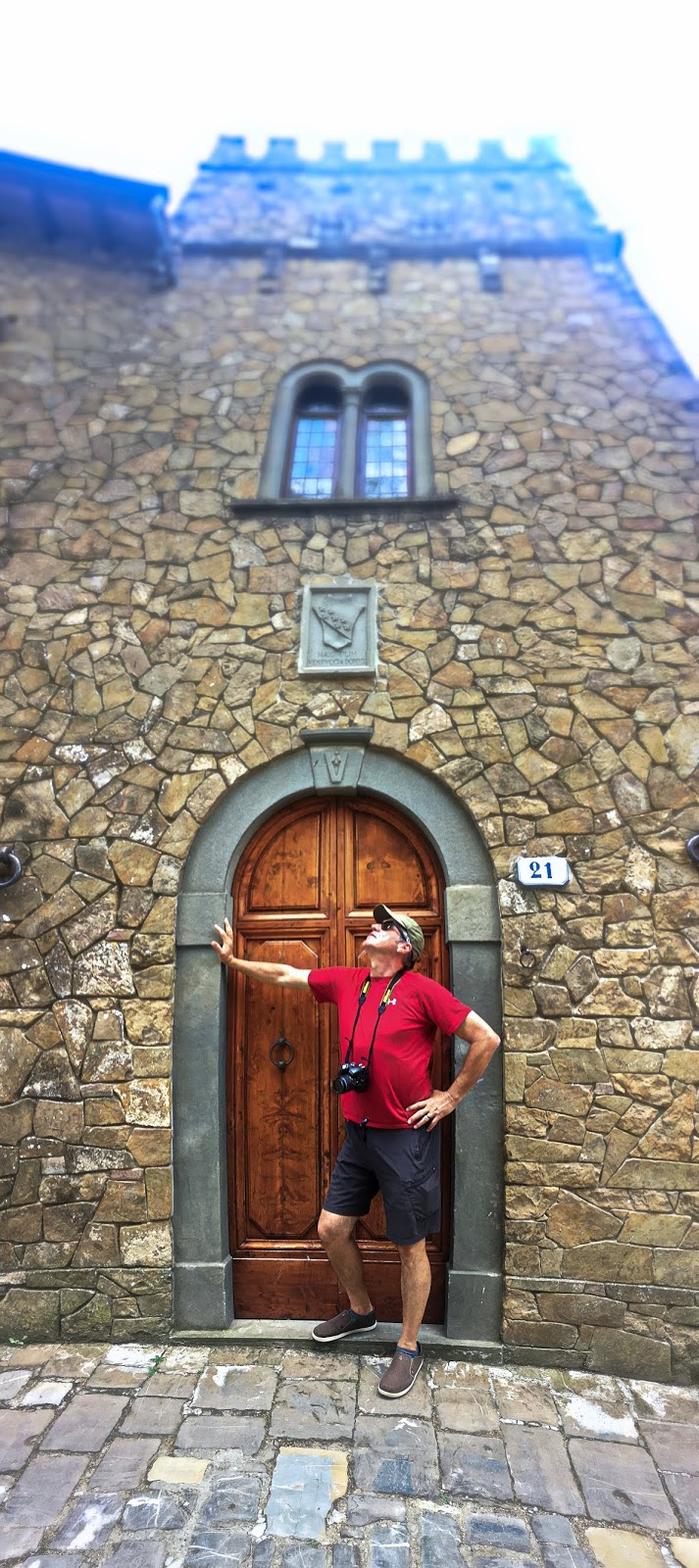
You can’t beat the view from a hilltop medieval castle village, and Montefioralle is a prime example. We lost ourselves in the solitude of cobbled streets that were not much wider than an ox cart. The village is small. Quiet. There are no hotels. No gift shops. If you get hungry, there are three quaint restaurants to choose from. Indeed, the longer we lingered, the more we liked the place. In due course, we did locate the Vespucci ancestral country home where Amerigo was supposedly born. Above the doorway, a stone plaque in the wall is engraved with the family coat of arms: a shield with a banner of wasps (the Vespucci surname is derived from “vespa,” which is wasp in Italian and Latin). Should I knock? Nobody seemed to be home. The address is 21 Castle Way. If you ever get to Montefioralle, rap on the door. If anyone answers… Ask ‘em if Amerigo is home. 

A view of Greve from outside the walls of Montefioralle.

The streets of Montefioralle.

Hitch your horse here. And pick up your horse poop.

Lost. In a good way.  

Lunch with a view.

Amerigo Vespucci

The Vespucci residence.

The Vespucci  house cat?


Ritorno a Venezia

“How sweet the moonlight sleeps upon this bank! 
Here will we sit and let the sounds of music creep in our ears.”   
         —William Shakespeare, The Merchant of Venice.

Inevitably, all good journeys come to an end. We packed and departed Greve in Chianti after breakfast, heading north with Tuscany in the rearview mirror. Three hours later we were dropping the car off at Marco Polo Airport, and then catching the water bus out to Venice—where it had all started. It was our last night in Italy. We sprung for a suite on the Grand Canal.

After spending three days in Venice on the front end of the trip, it didn’t take long to get our bearings again. We wandered the San Marco borough; browsed through the shops one last time; found a romantic, out-of-the-way restaurant for dinner. Then we joined the throng in Saint Mark’s Square at sundown, pigeons wheeling overhead as the voice of a woman singing opera drifted across the plaza and the day succumbed to the night.

La fine.


The view from our hotel.


Drinks in Saint Mark's Square. Cin-cin!

A little opera for ambiance.

Sundown in Saint Mark's Square.
  
~~~~~~~~~~~~~


Trip Summary...


THE JOURNEY 
We logged 890 miles on the Audi. Though we didn’t need a car in Venice (no streets!), and it was parked the whole time we were in Florence, it was definitely handy everywhere else along the way. Terry loved the car. It had cup holders. 


THE ETHOS      
The Italians call it “La Vita Bella”—the beautiful life. And they don’t mean a “luxurious life”, but rather a relaxed, family-centric lifestyle that puts quality over quantity. There is no such thing as Italian fast food: their culture transcends “quick and cheap.” Meals are eaten unhurried. At restaurants, food servers won’t bring your bill until you signal for it—dropping it off before you ask is considered rude. Italians love their vino and can be the zest of the party—but over-drinking in public is considered boorish. And they don't rush around clutching a to-go cup of coffee: they relax and sip their espresso at a coffee bar or bistro table. There is much more emphasis on how time is spent rather than being on time. Family is everything and extended-family dinners on Sundays are common.

THE FOOD   
Italian cuisine is the bomb. That is all. 

Yes, I know what you’re thinking: What about all that fancy French food? Well, it came from Italy. Remember Catherine de’ Medici, the girl from Florence who married the French prince and later became Queen of France? She was appalled with the mundane food of French royalty and their habit of eating with their fingers, so she brought her own chefs to Paris—including Ruggeri and his top-secret ice cream—and transformed their abysmal diet into what we know as French cuisine today. Also, she introduced them to the dinner fork. No more fingers. But back to Italy: If I had to pick some meals from the trip that stood out above the rest, they would be the beet ravioli at the Lagazuoi Rifugio; the lasagna in Cortina d’Ampezzo; and the roasted wild boar in Canazei. They were incredible. Oh, and pizzas were popular everywhere and they were all good.      

THE TOAST       
One night, a waiter poured our wine and said “Cin-cin!” when he was done. It sounded like he had said “ching-ching”, like the sound of two glasses clinking together in a toast. Later I discovered that it means “To your health,” similar to “salute” or “cheers” or “tally-ho” or whatever. Cin-cin. I like the ring of it.  

BREWS & LIBATIONS
Beer-drinking seemed to be more prevalent in the mountain towns, though we didn’t sample many. Pale lagers such as Peroni are popular. My favorite was a Moretti La Rossa (red ale?). Down in the warmer climes of Venice and Tuscany, there were a couple of summer drinks that are uber-popular with both locals and tourists. One is the neon-orange Aperol spritz, made from Aperol (a citrus/rhubarb liqueur), Prosecco (an Italian white wine), and soda water. The other is the Negroni, made with sweet vermouth rose, gin, and Campari (a liqueur of fruits, herbs and spices). If these drinks aren’t your thing, there is always plenty of Chianti wine. As I said earlier, the Italians love their vino—and they drink more of it per-capita than the French.  

Cin-cin! 


Navigation to...

PART ONE      PART TWO      PART THREE


Friday, March 1, 2019

On the Road in Italy (part 2)


You know you’re having a good day when the car rental agent can’t find the Ford Fiesta that you reserved, and all they have left to give you is an Audi Q3—for the same price as the Fiesta. Turbo-charged, two-liter engine. Premium sound system. Leather seats. Ummmm… Okay, I’ll take it.

We were soon jetting north on Autostrada 27, across bucolic flatlands of cultivated fields and farm houses, Terry feeling right at home behind the wheel of a sleek Audi. A wall of blue-gray mountains loomed on the horizon ahead, shrouded in mist and clouds. The Dolomites beckoned. And for the next week, these majestic alps would be ours to explore. 
~~~~~~~


Cortina d'Ampezzo

Our first four nights in the Dolomites were at a mountainside inn overlooking the town of Cortina d’Ampezzo. It made for an excellent base camp for our sorties into the high country. There are only a few thousand permanent residents in the Ampezzo Valley, though a flood of visitors can fill the hotels and chalets during the winter ski season. Long known as the “Queen of the Dolomites”, Cortina gained repute for being the “in” place to ski for European aristocrats and celebrities. The 1956 Winter Olympics was held here, as well as many World Cup ski events. The spectacular alpine setting also lures filmmakers: The original Pink Panther and the edge-of-your-seat Cliffhanger were both shot in and around this valley.   

There was no snow on the ground when we were there (it was July) but there’s still plenty to do: Hiking; climbing; cycling… Road cycling is big. We drove the steep, narrow, switch-backing roads up to Giau Pass and Falzarego Pass, and I’m here to tell you that those climbs would be butt-kickers on a bike—and we saw dozens of riders cranking it every day. And then there’s the mountains. Big mountains. Kids around here learn to ski before they can walk, and start bagging peaks soon after that. Lino Lacedelli was a Cortina homeboy, and in 1954 became the first to stand on the summit of K2, the second-tallest mountain on the planet. The Dolomites are dripping with mountaineering lore, harking back to the 19th century. Which was the main reason for us coming here: to follow the same tracks and grasp the same handholds as the early alpinists.   

Our lodging at the Piccolo Inn was a couple miles out of Cortina, on the winding road up to Falzarego Pass. The innkeeper, Paolo, checked us into our room and showed us around. He was tall, lanky and bearded; wore faded jeans and cowboy boots. He also rode a vintage Triumph motorcycle, played guitar, and was a huge fan of Neil Young. We got along fabulous. 

Cortina d'Ampezzo

Promotional poster from the 1920s.

Tofana di Rozes (10,580 ft)

Cyclists grinding up to Falzarego Pass.  

Terry was in her element on the twisty mountain roads. And she sure loved the Audi. I rarely got to drive it. 

The little chapel on Falzarego Pass (6,910 ft).

Giau Pass (7,340 ft), with the mighty Ra Gusela towering over it. 

Our not-too-shabby view from the terrace of the Piccolo Inn.


The Alpine Front

By 1915, the towns and hamlets in the Italian Alps, collectively belonging to the province of Tyrol, had been under Austrian rule for four centuries. In Cortina—only seventeen air miles from today’s Austrian border—nearly half the residents spoke German and claimed Austro-Hungarian roots, living harmoniously with their Italian and Ladin neighbors. But that would soon change.

The First World War had already been raging for a year when Italy joined the Allies in 1915 and attacked Austrian troops in southern Tyrol. When they advanced on Cortina, the Austrians fell back to Falzarego Pass and turned Lagazuoi Mountain into a fortress of tunnels, artillery emplacements and machine gun nests. A fierce three-year struggle ensued for control of the region, known as the Alpine Front, with both sides deeply entrenched in a stalemate. When the Austro-Hungarian Empire began to crumble in 1918, they sued for peace and agreed to relinquish South Tyrol to Italy. A young Ernest Hemmingway was a Red Cross ambulance driver for the Italian army on the Alpine Front, and his experiences were the catalyst for his classic novel, A Farewell To Arms.

Today you can explore the maze of tunnels and old fortifications on Lagazuoi Mountain. We spent most of a day here, tramping along rocky ridges and probing into pitch-dark tunnels (headlamps required). The Lagazuoi Tunnels route is a Via Ferrata, which means “the iron way.” It incorporates fixed lengths of steel cable, stanchions, even ladders, on precipitous rock terrain to make the going much safer. They’re also rated for difficulty, similar to rock-climbing ratings, so that you know—theoretically—what you’re getting into. The Lagazuoi Tunnels was rated “Easy”, so we left our climbing harnesses in the car with the hopes that “Easy” meant easy. And it was.

Our visit marked the 100th anniversary for the ending of hostilities in the First World War, and to commemorate, re-enactment buffs in WW1-era uniforms of the Italian and Austrian armies, complete with vintage pistols and rifles, were patrolling the old trenches along the ridge, chatting with tourists and explaining what it was like to fight a war at 9,000+ feet—even in winter with fifteen feet of snow on the ground. Later that afternoon, on the Lagazuoi Rifugio patio, we spotted a group of Italian and Austrian soldiers with mugs of beer, gabbing and laughing. The hostilities are evidently a thing of the past.     
         
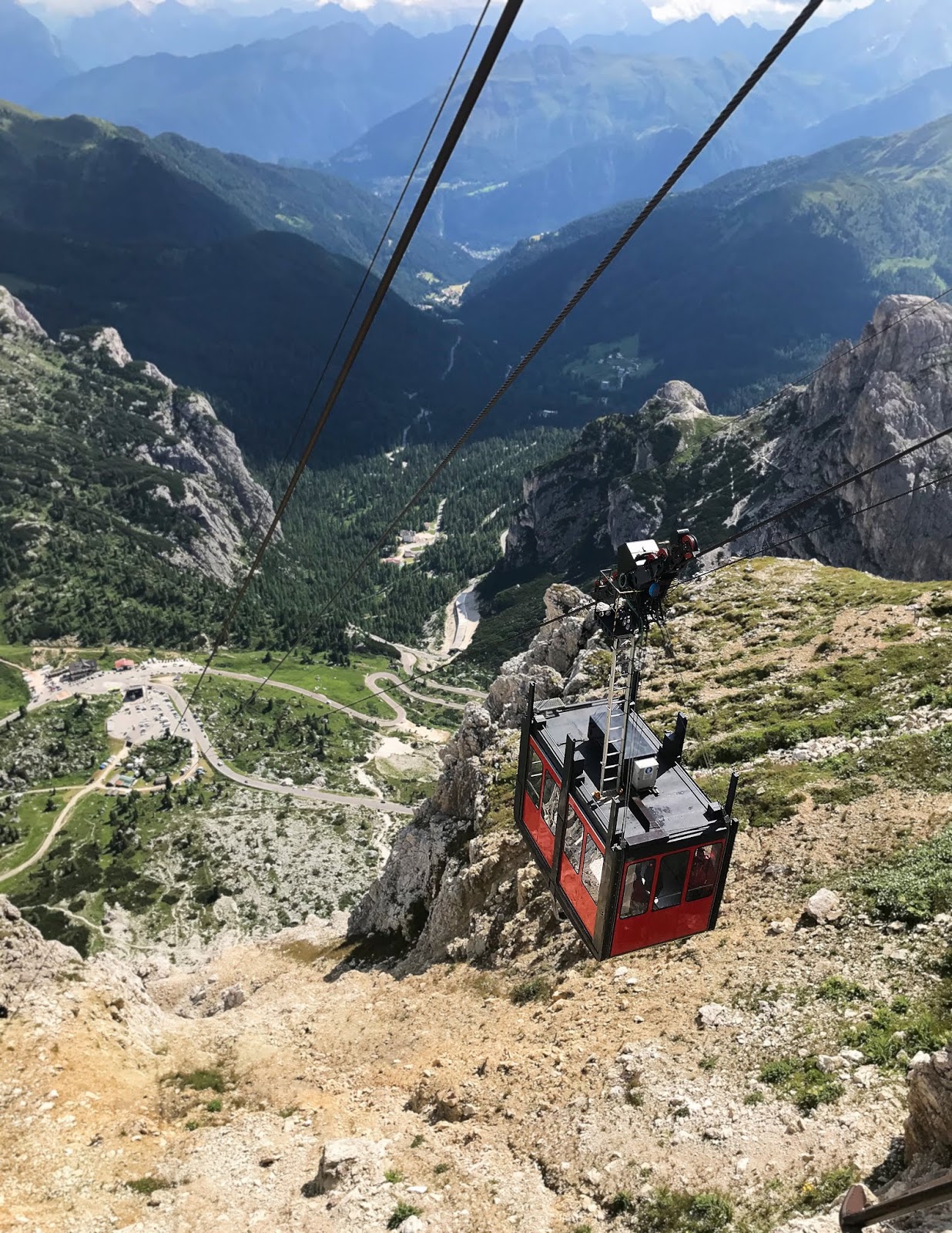
The cable car from Falzarego Pass up to the summit of Lagazuoi Mtn (9,300 ft).

Lagazuoi Rifugio at the top of the mountain.

WW1 Italian Alpini soldiers on patrol. All their gear looked authentic: leather backpacks; hemp climbing ropes; ancient ice axes; vintage weapons. The elite Alpini, also known as the Black Feathers (you can see the feather in their caps) were trained for mountain warfare. Formed in 1872, they are still active today, recently serving in Afghanistan.  

An old photo of Austrian mountain troops ascending treacherous terrain.

Entrance into Lagazuoi Tunnels

An observation window in one of the tunnels. Troops literally lived inside the mountain.

The view from summit of Lagazuoi Mountain.
In background is Monte Antelao (10,710 ft) and
the Ampezzo Valley.


Climbing with Walter

We had our heart set on climbing in the Dolomites for a few days, but lugging a heavy bag of ropes and hardware across Italy for close to three weeks did not sound appealing—not to mention the airline charges for extra baggage. 

“Get a guide,” my friend, LeRoy, recommended.

And so, we did. LeRoy referred us to OnTop Mountaineering, the outfit he uses in Europe, and we locked in the dates and guides before leaving home. All we had to do was bring our harnesses and rock shoes; the guides would supply everything else.

Our guide in Cortina was Walter, a wiry fellow who grew up in the German-speaking region of South Tyrol. Like many Tyrolean kids, Walter grew up skiing big mountains and grappling vertical rock. Now he’s a certified IFMGA mountain guide, leading clients on ski tours and climbing ventures, an adventurous job that he has been doing now for eleven years. We had two days booked with him. One of the days, we wanted to sample the routes on Cinque Torri, and on the other, we were interested in doing a classic Via Ferrata, whatever Walter could recommend.

“We’ll do Ferrata Tomaselli,” he proposed.

Eccellente!

So, we had a plan: Tackle the Ferrata Tomaselli first. We packed the night before and set the gear at the foot of the bed. It was around midnight when we were awakened by the crack and boom of thunder. Jagged bolts of lightning flashed outside our window, followed immediately by more thunder. Then the sound of heavy rain pattering on the roof over our heads, which then turned into a clamorous drum roll of hail. Crap. The best we could hope was that it would clear up by morning.   


FERRATA TOMASELLI
Walter and his German girlfriend, Miriam, met us in the parking lot at Falzarego Pass first thing in the morning. The storm clouds were breaking up as we rode the aerial tram up to Rifugio Lagazuoi, where it’s a two-hour approach to the base of the Ferrata Tomaselli. And as soon as you clip into the steel cable and start climbing, you start hoping that it doesn’t get any tougher, because right off the bat, it’s steep and exhilaratingly exposed. Which is why Tomaselli gets a 5C rating, the top end in technical difficulty and commitment on the Via Ferrata scale. (In comparison, the Lagazuoi Tunnels that Ter and I had done the prior day was rated 1A, as easy as it gets.) Even more mind-boggling, the first ascent was done by the Austro-Hungarian army during WW1; some of the original ladders—dilapidated and scary-looking—are still hanging on the rock walls.

We were two-thirds up the route, however, when Walter called us to a halt and scrapped our summit bid. Ominous dark clouds were coming our way, and we were clipped to a steel cable that ran all the way to the summit. If a thunderstorm struck… Basically, we were attached to a lightning rod.

Now what, you ask? Walter had a plan. We followed him west along a ledge system that traversed across the sheer face of the mountain. After a considerable distance the ledge terminated at the entrance to a WW1-era tunnel, and donning headlamps (sure glad we packed them), we scrambled through solid rock to the other side of the peak! From there we worked our way across snow, rock and scree to the descent route and started the long hike down to the parking lot. We were halfway down when it started to rain.     

Starting our approach. The objective is the highest
butte on skyline at center of photo, which is Cima
Fanis Sud (9,780 ft). 

The Ferrata Tomaselli is shown in red. The climbers descent route is in green. 

Geared up near the start of the climb and ready to go. It was mostly sunny at first... But it wouldn't last.

Walter and Terry on the crux traverse. Big air down
to the deck here. 

Rickety remains of the original route put up by the Austrians during WW1. Not recommended. Obviously.  

The route now goes around the rickety ladders. Quite steep, but the holds are there when you need them. 

Getting higher.

Miriam and Terry at the tunnel that leads to the other side of the peak.

Nice views on the hike back down to Falzarego Pass.
It started raining soon after I took this shot.


CINQUE TORRI
The Five Towers rise majestically along a ridge just below Falzarego Pass, the highest about four hundred feet tall. It’s a rock-climbing paradise—and you can’t beat the approach. Walter met us in the parking lot for the chairlift that takes you up to Rifugio Scoiattoli. From there, it’s a mellow six-minute stroll over to the crags! We climbed a bunch of routes, but here were the most memorable…

Standard Route (5.6) on Torre Quarta Bassa. First ascent was in 1911 by Cortina hardman, Angelo Dibona. He served as a mountain guide in the Italian army in WW1, and afterwards, put up a slew of first ascents in the Dolomites.

Northwest Corner (5.6) on Torre Seconda. All I can say is… 5.6 my ass. More like dead-vertical 5.8+ off-width squeeze chimney grunt-fest. I got spanked. Ter got spanked. Walter didn’t even break a sweat. First ascent was in 1934 by Angelo’s son, Ignazio Dibona. 

Rosamunda (5.8) on Torre Grande. Sport climbing in Italy! A beautiful bolted line up a steep arete. First ascent unknown. (Maybe late 1980s by sport climbers in Spandex tights?)

Cinque Torri basks in the sunlight in foreground. Torre
Grande is the largest tower. The tiny structure (which
isn't so tiny) on the grassy ridge to the right of the towers
is the Rifugio Scoiattoli.
  

"Standard Route" on Torre Quarta Bassa is shown in red. Three pitches of fun climbing. The crux is turning the triangular roof a third of the way up.  

Under the triangular roof at top of Pitch 1.

Firing the roof and up she goes...

Looking across the abyss at two climbers on Torre Inglese. 

Walter and Ter at the rap anchors. It's a double-rope rappel to get off Torre Quarta Bassa. 

"Rosamunda" on Torre Grande.  

After a superb day at the crags, what better way to enjoy Italian beer than on the sun deck of Rifugio Scoiattoli. I could get used to this. No problema.        


Canazei and South Tyrol

Forty twisting, mountain-road miles west of Cortina d’Ampezzo, passing over two high passes along the way, lies the unsullied hamlet of Canazei, where we would stay for the next three nights. We rented a room at the Garni Stella Alpina, a Tyrolean-style inn near the old town center. Next door was a quaint, 500-year-old church. Across the street was a tavern called Osteria La Montanara (Mountain Inn), where specialties included sauerkraut, goulash, wild boar when in season—and, of course, a good selection of local beers. Canazei is primarily a Ladin community, where the spoken language and customs hark back to Roman times. So, while the road signs and official language may be Italian, it frequently takes a back seat to Ladin and Germanic influences. 
   
Like Cortina, Canazei is all about the mountains—only more so. Maybe it’s because the highest peak in the Dolomites (Mt. Marmolada, 10,968 ft) is just five miles away, its ramparts gleaming with the only large glacier in the range. Or maybe it’s because everywhere we ventured was like the opening scene from The Sound Of Music (Ter is a fabulous singer and can pull this off. I can’t). Irrefutably the alpine meadows were in full bloom.

And what trip to the Italian Alps would be complete without a drive up to South Tyrol, home to not only our Cortina guide, Walter, but also the legendary alpinist, Reinhold Messner? Outside the town of Bruneck, we caught the aerial tram up to the summit of Mount Kronplatz, which is where you’ll find the Messner Mountain Museum. Reinhold Messner is one of the most—if not THE most—prolific alpinist/adventurer of modern times, and I could go on forever here talking about his mountaineering achievements alone. (But I won’t.) Now in his mid-seventies, Messner has climbed in all the great mountain ranges of the world, and along the way, collected all sorts of things, from indigenous artwork to mountaineering memorabilia. The climbing stuff he collected is on display at the Mount Kronplatz museum. (In all, there are six in the Dolomites, each focusing on a different theme.) There’s an oxygen tank that was used in the first ascent of Mount Everest in 1953; Edward Wymper’s hemp rope that was used in the first ascent of the Matterhorn in 1865; the ice axe belonging to Toni Egger, who fell to his death in 1959 while attempting a controversial first ascent of Cerro Torre in Patagonia… The vibe was like going to church to behold sacred artifacts. Or coming home to the mountains.   

Charming Canazei, where we stayed at the inn at right.  

The stream that runs through Canazei.

The view from Sella Pass. Canazei can be seen far
below in the distance. 

Horses in an alpine pasture.

Village in Gardena Valley.

Messner Mountain Museum Corones on the summit of
Mount Kronplatz. Completed in 2015. Designed by the 

renowned architect, Zaha Hadid.  

Mountain maiden.


Climbing with Marika

Our last full day in the Dolomites was spent… Wait for it… Rock climbing. Our guide this time around was Marika, a dynamic woman with a beaming smile. She grew up right here in the Fassa Valley in a Ladin-speaking community. Her dad put her on skis when she was three years old. At age six, she was competing in races. She made the Italian Alpine Ski Team, her forte being the super-G and downhill—the fast and scary events. This landed her an athletic scholarship to Sierra Nevada College in Lake Tahoe, where she competed on their ski team. After graduating, she returned to her beloved Dolomites and became a ski instructor until she could figure out her next move. That’s when she took up climbing as a serious pursuit. Her father had made a living as a mountain guide. Why not her?

Marika met us at our Canazei inn, and the three of us took our car up to Sella Pass. We already had our route picked out, courtesy of Marika’s recommendation. Looming above the pass are the impressive Sella Towers, and our objective was a classic, five-pitch line on the First Tower called the Trenker Route (5.7). The first ascent was done in 1913 by Luis Trenker, a South Tyrol hardman who was just twenty-one at the time. Young whippersnappers.

At the base of the climb, Ter and I flaked out the ropes as Marika selected the gear: just eight cams, that’s all she was taking. Which means she’s done this route many times and knows exactly what’s needed and nothing more. I asked her about belay signals, just to be sure we were on the same page.

“When I’m off belay, I whistle,” she said. “When I’m ready for you to climb, I whistle again.”

Umm… But what if we don’t hear her whistle?

She flashed us that beaming smile. “Oh, you’ll hear.”

She flew up the first pitch and quickly built a belay anchor. After clipping into it, she whistled down that she was safe. And oh yes, we heard her. Easily. Terry took her off belay and Marika pulled up the slack in the twin ropes. When they were taunt, she emitted another whistle-shriek to let us know that she had us on belay and to start climbing. That became the natural rhythm of things, pitch after pitch, higher and higher, until we were sitting on the summit of Prima Torre Sella.

I asked Marika who taught her to whistle like that, and she smiled.

“My father.”

Delicate downclimbing and two double-rope rappels got us down to the climbers’ trail leading to the Sella Pass parking lot. We grabbed some food and beer at a small, outdoor bistro nearby and basked in the afternoon sun. It was an excellent way to end a day on the crag. And for that matter, an excellent way to end a week in the Dolomites.   

Marika is all smiles at the base of the climb, ready to start up the first pitch. 

First Sella Tower with "Trenker Route" shown in red. Five pitches up a giant corner, and then 4th class scrambling (dotted red line) up the tower's west arete to the summit. 

Luis Trenker in the 1931 film “Mountain On Fire”, in which he wrote, directed, and played the leading role. Trenker led a prolific life. He was an avid climber and skier; served in the Austrian army on the Alpine Front during WW1. He later became a successful actor and filmmaker of Italian and German language films, his tough and rugged demeanor earning him the nickname “John Wayne of the Dolomites”. He passed away in 1990 at the age of 98.     

Marika leads the crux Pitch 2: a steep, off-width corner where wide stems are the rule. Also, the limestone is polished from a century of foot traffic, so all the holds felt greasy. “Trust your feet” was the mantra. Oh, and it’s fairly runout: glad Marika was doing all the sharp-end work.  

At the top of Pitch 4. The views just keep getting
better and better.

Summit photo. The higher Second Sella Tower lurks in the background.

Alpine bliss on the trail back down to Sella Pass. 
~~~~~~~


We packed our bags in the morning with some regret and checked out of the Garni Stella Alpina. It was akin to half of you not wanting to leave. Reinhold Messner once said: “All climbers come to the Dolomites—just as they go to Yosemite—at least once in their life.” He may be biased, for Le Dolomiti has been his home and back yard since birth. But after spending a week climbing, hiking and driving around Reinhold’s “back yard,” I would have to agree with him. Which made it difficult to say ciao. Nevertheless, it was time for us to move on. Next stop: Florence…


Navigation to...

PART ONE      PART THREE      PART FOUR