Friday, September 29, 2017

Kayaks in the San Juans - (Pt.1)


Terry found the trip online: "Five Days in the San Juan Islands". In a kayak. On water. With killer whales under the water. In a nutshell, my wife grew up sailing on Long Island Sound, so perishing at sea is in her blood. At least that’s my perspective. I can count on one hand the times I’ve been in a sea kayak—and those were day trips on docile waters. But five consecutive days of paddling in the Salish Sea?

“Come on, what’s not to like about this trip?” she posed.

Okay. Up to a point, she had a point. We would be navigating through a stunning archipelago off the Washington coast, exploring enchanted isles, sleeping under the stars, communing with eagles and seals and, yes, possibly even those humongous orcas that lurk under the waves. It did sound enticing. From the time I first laid eyes on the San Juans three decades ago from the railing of a Canada-bound ferry, I was hooked on their mystique and rugged beauty. Terry and I had visited Orcas Island in 2008. We had hiked to the summit of Mt. Constitution—the highest point in the island chain—and stood in awe over the panoramic view of all those islands spread out before us. We both felt compelled to return some day. And here we were, nine years later, ready to do some in-depth exploring.
~~~~~~~~~~~~


We booked the trip with Anacortes Kayak Tours, which Ter had selected due to their unique trip itineraries and stellar Yelp reviews. AKT would handle all of the logistics, gear, and food. All we needed to do was show up at the point of departure with our clothes and sleeping bags. Our journey would begin on San Juan Island, out at the west end of the island chain, and end five days later at the ferry/seaport town of Anacortes on the mainland. In all, we would be paddling about 45 miles. Rain or shine.


We arrive in Friday Harbor on San Juan Island on a Saturday afternoon, taking the ferry out from Anacortes. Our kayak trip doesn’t begin until Monday, so we have tonight and all of Sunday to explore the island before we depart. Friday Harbor is a quaint little town of 2,300 people, the largest town in all the San Juans. It was named after Joe Poalie Friday, a native Hawaiian who herded sheep here for the Hudson Bay Company in the 1870's. Just sixty air miles from Seattle, it is a bustling place at the peak of summer, but sleepy and tranquil in the winter—at least that’s what a local told us, who prefers the town in its off-season sleepy state.


Dining on the Friday Harbor waterfront.


On the road to Cattle Point at the south end of San Juan Island. We rented scooters for Sunday. Ter had never operated a motor bike of any kind before, and she was a little apprehensive at first. I told her it was no different from her mountain bike, other than this had a throttle. Piece of cake. The island is 55 square miles, so touring the countryside on scooters was definitely the way to go.


A red fox saunters over to where we’ve stopped at a turnout. He was looking for a handout, practically doing handsprings to get us to feed him. Dude. Go catch a vole.


The Pelindaba Lavender Farm was one of our stops, where the San Juan Island Lavender Festival was in full swing, complete with a trippy marimba band. We roamed through the fields, listening to the music, and sampled the homemade lavender/vanilla ice cream (pretty good) and lavender brownies (tastes like soap). There are 25 acres of Lavandula of numerous species being cultivated here.  


This stainless steel sculpture, called Pi in the Sky, sits in the middle of a lavender field. Several local artists were showing their work at the festival. Cool stuff.


A century-old lighthouse stands vigil on Lime Kiln Point on the west side of the island. Off in the distance, on the other side of the Haro Strait, is British Columbia, Canada. In the mid-19th century, the San Juan Islands were claimed by both Great Britain and the United States, with settlers from both countries beginning to move in and homestead parcels of land. Things escalated until an American farmer shot a pig that was rooting in his garden—a pig belonging to a British subject—and thus sparked the Pig War. It took years to straighten out. Ultimately, it was negotiated that the Canadian/American border would run down the middle of the Haro Strait, giving the San Juans to the United States. As for the dead pig … it was the only casualty in the conflict.  


. . . . . . . . . . . . . . . . . . . .
JULY 16th –
Enjoyed a great day touring San Juan Island on motor scooters. We did a full loop, about 40 miles. Beautiful coastline! Afterwards, we had dinner again on the Friday Harbor waterfront. Now we’re in our motel room, sorting gear and setting aside what will go on the kayak trip. The things we don’t need will be given to AKT, who will then ferry it back to Anacortes and store it in their office until the end of the trip. Ter is fretting about getting cold at night. Finally, she tosses another layer of warmth onto the “kayak” pile. On the TV, the weatherman predicts a chance of rain by mid week. Reality sets in: We’ll be paddling for five days, rain or shine. But we’re ready for it. We’re stoked. 
. . . . . . . . . . . . . . . . . . . .


There’s a flurry of activity on Smallpox Bay in the morning as kayakers prepare to launch. It’s a popular put-in site on the west side of the island. We arrived on time, but there had been a snag: the ferry bringing our kayaks and guide out from Anacortes had broken down. When they finally arrived (the three nearest kayaks are part of our group), we quickly loaded up and shoved off.


After a 2½-hour delay on getting started, we are on the water and paddling north, up the coast of San Juan Island. There are four kayaks in our AKT flotilla: two tandems and a pair of singles. Terry and I got the yellow tandem, where my wife jumped in the forward cockpit and appointed herself captain. I’ve got the aft seat, which operates the foot pedals that control the rudder. It took some time for me to get the hang of steering, for I was constantly over-correcting, or my foot would pop off one of the pedals, and Captain Bligh would snap: “More to the right! …Left! …You’re off course! …No, right!” It was all new to me: synchronizing our paddle strokes; maintaining a fluid rhythm; staying balanced and on course. The cross-wind and sea currents certainly didn’t help matters, either. But as the day progressed, my piloting skills improved. Otherwise, there would’ve been a mutiny.


Our AKT guide, James, leads the way across the glassy surface of a kelp forest off Spieden Island. These underwater forests along the shorelines dampen the waves and sea currents, making for a mellow paddle over the top of them. Seals and salmon use them to hide from killer whales.


Zenzi cruises along the shoreline of Spieden Island. She’s one of the four clients on the trip, and the only client who has any kayaking experience. As for Spieden, it had this "Mysterious Island" allure going for it. In the early 1970's, it was used briefly for hunting big game. Exotic animals, including lions, tigers and rhinos, were brought in, where game hunters then paid for the privilege of shooting them. From a van. The proprietors of the operation called it Safari Island. But the general public, once they discovered what was going on, called it an outrage, and before too long, it was shut down. Today the 500-acre island is owned by James Jannard (founder of Oakley), and nobody lives here but the resident wildlife, which includes Mouflon sheep from Corsica, and Sika deer from Asia.


James stands back as his guide apprentice, August, shows off his culinary skills. We made camp for the night on Stuart Island. We’re sitting around the table here, hors d'oeuvres and Glenfiddich close at hand, watching these guys whip up an incredible dinner. Camp chefs, extraordinaire.  


A short hike up the hill from camp is the Stuart Island School. Pictured are the old classroom (left) and library/office. A more modern building—with indoor plumbing—was added nearby in the meadow in 1980. Even today, only about forty people live on the island year-round, and hence the school never saw more than a handful of students. In fact, it closed down in 2013 because there were no kids to teach.


Looking across the Haro Strait into British Columbia. At sunset, we all hiked up the steep, faint trail to the summit of Stuart Island, and caught this magnificent view along the way. Stuart is the northern-most island of the San Juans, and it’s not very big (less than three square miles). To live here means living completely off the grid. There are no restaurants, stores, or markets. There is also no ferry service, which is how the island has managed to preserve the pristine, wilderness ambiance that many of the others in the archipelago have lost. And that is precisely the way the residents here like it.


. . . . . . . . . . . . . . . . . . . .
JULY 17th –
Our first day on the water was a long one. We paddled around 11 miles, getting a late start and arriving at camp later than anticipated. James and August cooked up a great pasta dinner. There are six total in our group, giving the trip an intimate feel. The two other clients, Zenzi and Allison, are wonderful ladies. Zenzi is from Austin. Allison comes from St. Louis. We make a good bunch, with lots of gaiety around the camp table. After dinner, we went for a hike and scaled the island's summit at sundown. Spectacular! We came back down through the woods at nightfall, owls hooting in the dark. Now we’re in our tent, rubbing sore shoulders and backs—and taking more ibuprofen. We are total newbies at this kayak thing, but loving it. More miles to pull tomorrow. 
. . . . . . . . . . . . . . . . . . . .


Day 2: After breakfast and breaking camp, we all lend a hand to carry the gear down to the beach, where James meticulously stows it away. I am amazed at the amount of cargo these kayaks can carry.


Departing Stuart Island, across a windless, Salish Sea that's as smooth as glass.


We stop for lunch in a driftwood cove on the northeast side of San Juan Island. Warm and sunny, it’s a perfect beach day.


Our campsite on Jones Island is possibly one of the best in the universe. It even had a tree swing!  But oddly, James was very averse to ever camping on this island again.

“Raccoons,” he warned. “They’re out of control.”

“It's the Raccoon Mafia,” August added with a perfect Sicilian godfather accent.

James expounded on how the wily critters raided your camp after dark; tore into packs; tried to steal your food; kept you up half the night. However, we had already paddled nine or ten miles today, and the next potential campsite was several miles further along. That didn’t sound very appealing, either. So, James left it up to us, the paying customers. And we chose to take our chances on Raccoon Island.


A poster on the Jones Island message board.


photo by Zenzi Griffin
A dining table with a view. Sitting across from me is Allison from St. Louis. She had just graduated from college, flew out to Portland, bought a used truck with a camper shell, and then drove up to Seattle for this kayak trip. Afterwards, she’ll drive up to Squamish in BC to go rock climbing, and then meander down to Yellowstone and Jackson Hole, and who knows where else in the West. She’s on an adventure.
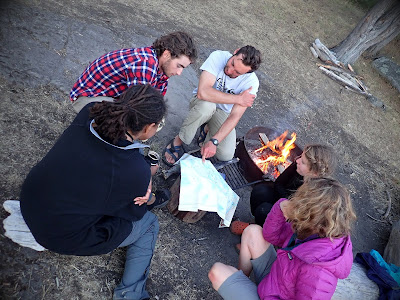


After dinner, James brought out his chart and we gathered round. As our guide, he had invaluable knowledge for navigating through this maze of islands. On the chart, he had marked small arrows, red and green, at key channels between the islands. The red arrows indicated the sea current’s direction during ebb tide. The green arrows showed the direction during flood tide. Using an app on his iPhone, he could then synch with the latest tide tables and interpolate the speed and direction of the current at various locations over the next 24 hours. This was important, because the peak-tide velocities in the narrower channels could be significant. (Case in point, Deception Pass, which we would NOT be going through.) After he had the tides dialed in, James then checked the latest weather forecast, and from all of this information, he plotted our intended route for tomorrow, seeking the path of least resistance. “Threading the needle,” he called it. Bottom line: A front was moving in, and we would be paddling into a headwind first thing in the morning.


Day’s end on Jones Island. This serene isle is much smaller than Stuart (about 180 acres), and a Washington state wilderness park in its entirety. There’s nothing here but campsites, secluded coves and hiking trails.


. . . . . . . . . . . . . . . . . . . .
JULY 18th –
Another splendid day—though the shoulders are sore again. We left the rainfly off so we can gaze up at the stars tonight. The latest forecast calls for a chance of rain the next two days, but it's remarkably clear right now. The wind is sighing through the trees. Waves lap rhythmically onto rocks. The campfire crackles and pops. It’s utter enchantment. Haven’t seen any raccoons lurking about, but still ... to allay the worries, I helped James and August suspend all of our food from a high tree branch (including our good Scotch). It’s bomb proof, no way can they get it. Pretty sure. 
. . . . . . . . . . . . . . . . . . . .


TO BE CONTINUED...


Wednesday, August 9, 2017

Back in the Saddle


I remember it well. I was hurtling through the last turn of the ride that I do with my neighbor, Ian, every Wednesday morning in Chino Hills, when a bee suddenly smacked me in the face and wedged itself under the frame of my sunglasses. Buzzing angrily, it then stung me on the cheek. This unprovoked attack set me up for a spectacular crash-n-burn, and when the dust had settled, I was flat on my back, unable to move. Ian rushed over and asked me what I wanted him to do. I told him to shoot me in the head for taking up such a ludicrous sport. But he said he couldn’t do that. Instead, he called an ambulance. Ian was also nice enough to call my wife at work—it was her first day back to school—and let her know that I was on my way to the ER.

That was eleven months ago. Since then, my left shoulder—which had sustained a serious AC separation—has returned to full functionality. And my right index finger, which had been badly dislocated, has mended to about as well as it will ever get. But more important, for those eleven months, I had stuck to my vow to shun bikes. I was quite content to stick with just hiking and rock climbing. If I ever wanted to spice it up, I could always indulge in pursuits that were wiser choices than cycling. Such as swimming with sharks. Or playing with rattlesnakes. The bicycles hanging in the garage collected a veneer of dust and cobwebs, and not once did I give them a second glance. I was over it. Done.

However, Terry didn’t feel the same way: She would rather go biking than play with rattlesnakes. It took me many months to get my head wrapped around that notion. (Just look at the data: There are way more mountain-bike injuries in the ER than snake bites.) I was stubborn. And she was patient (up to a point). Finally, I resigned myself to getting our neglected mounts, Fuel and Lush, cleaned and tuned up—and then hung them back in the garage. Another month passed. Then, the last week of June, we were on our way to Mammoth for a family campout, and wouldn’t you know it: Fuel and Lush were coming along.

My daughter, Heather, had put the trip together. She and her husband, CJ, were planning to camp for two weeks, while Terry and I would meet them there and stay a few days. We were looking forward to hanging out with family and in-laws; go on hikes; roast marshmallows with the kids; play in the snow (and there was lots of snow); and, of course, do some mountain-biking. I was stoked that I would be introducing my eight-year-old grandson, Logan, to the trails on Mammoth Mountain. He had cut his teeth riding the local hills around his home, and now he could sample the Real Deal. And granddaughter Hayden, as I would soon discover, was a little daredevil on her strider bike. She’s only four years old!

It is a wonderful blessing to be able to watch your grandchildren grow up. And it’s a double-blessing when they embrace an activity that you enjoy as well. Watching them ride bikes through the forest, whooping and shouting, brought the kid out of me. How could I not take to the trail again? If this was my wife’s grand stratagem… it worked. Now it was just a matter of steering clear of those damn killer bees.
~~~~~~~~~~~~


Dazzling blue skies greeted us at Mammoth Mountain’s Main Lodge. With all the snow that dumped this past winter, the upper mountain was still open for skiing. One could easily ski in the morning, and then switch to bikes in the afternoon.


Logan joined us for the day, and he was charged up, ready to go. We rode Downtown: a fun-flowing trail that starts at the main ski lodge and winds 5½ miles down through the forest into town. It was the perfect starter trail for Logan—and the only “green” that was open, as all the others were still buried in snow. 


Logan quickly gasped the nuances of finding the line through the turns. By the end of the day,
he had the banked hairpins wired.


The snowpack above us was melting like crazy due to the warm, sunny weather. There were stream crossings galore, the larger ones forded via temporary metal grates.  


The Loganator leads the pack. 


We rode Downtown three times, a total of about sixteen miles and 3,000 feet in elevation drop. It was Logan’s indoctrination to downhill riding. If he looks a little tired here, he should be. 


Fort Apache at Shady Grove Campground. This is Heather & CJ’s shiny new trailer. We held down four sites total, and there were so many kids running around, I lost count. Good times. 


Logan spent one night in our van, sleeping in the overhead berth with Toby. What’s it like sleeping with Toby? According to Logan, he hogs the bed.


The summit of Mammoth Mountain, and der Pudelhund’s first 11,000-foot peak in the
bag—though it might be considered cheating because he took the gondola up. What are
the canine rules on this? One thing for sure, he loves chasing snowballs and skiers.


Heather, CJ and the kids at one of the Mammoth Lakes. The Sierra Nevada has so much snow, the lakes are just now thawing out the last week of June.


Hayden and her mom are out for a morning ride. Miss Hayden is already a pro on her pink Trek Strider. It’s time to get her some pedals. 


An Interview with Downhill Diva, Hayden Morris

“You were quite fast on the mountain today, Miss Hayden.”
HM – “Thank you.”

“How old are you?”
HM – (Holds up four fingers.)

“Where did you get that awesome pink Strider?”
HM – “Grandma and Grandpa.”

“You ever consider adding brakes to that bike?”
HM – “Nope. Brakes slow you down.”

“What’s your personal goal in the downhill arena?”
HM – “Whup my brother.”

“Do you always eat your broccoli?”
HM – “Yep.”


.......................................................................................
To see all the photos from this trip, click HERE.
.......................................................................................


Wednesday, May 3, 2017

Return to Lady Mountain


Load 'er up. It was Terry’s spring break, and with the van all packed, we set out for the Utah desert on a resplendent afternoon. The road was calling. Destination: Zion National Park. The main objective: climb Lady Mountain.

My interest in Lady goes back to 2009 when Terry and I led four others, including Ter’s brother, Dan, on an ascent up the old trail—and I use the term “trail” loosely here. It hasn’t been maintained in fifty years. It’s rugged, hazardous, and not shown on any Park maps—in other words, my kind of trail. However, it took us way too long to find the start, and with the day getting late, we turned back two-thirds of the way up. (This is not a route to be caught descending after dark.) Flash forward to 2016, my long-time friend, Kevin Feldman, contacted me and wanted to rendezvous in Zion for some hiking and biking. “Sure thing,” I said, “but we gotta climb Lady Mountain.” Hence, once again, I scaled that nefarious trail with three of my pals—and once again, didn’t make the summit. We did get closer this time. But being close only counts when throwing horseshoes or hand grenades.

So now the pressure was on. With two strikes against me, I was stepping back up to the plate. But as they say: “The third time’s a charm.” This adage harks back to Shakespeare's The Merry Wives of Windsor, but this is what I was banking on. The lucky third try. I was stoked. There was no turning back. We’re doing this! However, there was only one. Little. Hitch. What do we do with the puppy?

Yep. No sooner had I made the campsite reservations back in February, than Terry was in contact with a family who was selling poodle puppies. Not one of those little critters, but a full standard poodle (picture a horse with curly hair). “They’re very intelligent,” she told me. Ha! Poodles, I countered, are wild animals. Don’t take my word for it, check out this video, which is pretty much how it went down. Regardless of my warning, we got the pooch. His name is Toby. And he was going to Zion.
~~~~~~~~~~~~


Toby the Trailblazer adapted to the van life like a duck to water. That said, the only reason he got to come on this trip—we certainly couldn’t take him up Lady Mountain—was because there was a kennel outside Springdale where we could board him for the day (where he had a puppy playmate, so he was quite content).    


Lady Mountain as viewed from the Zion Lodge. The old Cable Route snakes up the east
ramparts of the mountain, exploiting weaknesses up through the rock bands and along shear
walls. It’s a classic adventure climb and both of us were fixated on bagging the summit
this time. We planned to jump on it first thing Tuesday morning.


Terry scales the Moki Steps corner, the first obstacle at the start of the climb, and the first (of several) “don’t fall” zones. 


Bam! We’re through the first rock band. Our modus operandi for the day was to move fast. There would be no lunch break: all we carried were two Cliff bars, an apple, and just enough water to get the job done. Also a short rope and a couple of cams for pro.    


Ter makes a delicate traverse in the second rock band. The route threads up along ledges
and fissures in the headwall, the last obstacle being the Chimney pitch where we’ll flake
out the rope and do it fifth-class.  


Once the technical sections are behind us, we drop the rope and scramble up the Endless Staircase. Due to the exposure along these precarious walls, steel cables were installed back in the day to use as a hand line. However, this hardware was all removed when the Park Service abandoned the trail. The summit of Lady can be seen high above. We still have another thousand feet of elevation to gain. 


A strategically-placed cairn points the way. Above the Endless Staircase, the path zigzags through rugged gullies and spires, frequently seeming to fade and vanish. That’s when we’d inevitably spot one of these lucky ducks to get us back on track.    


After gaining the south shoulder of the mountain, a knife-edge ridge leads to the summit plateau. Big drops on both sides. Astoundingly scenic. We’re almost there! 


On top!! A Swiss family of four, who arrived soon after us, took this photo. They were one of
two parties that we met on the route. My first two attempts, we ran into no other people. So
from that perspective, it was a “busy” day on Lady Mountain! The Zion Lodge, where we got
off the shuttle bus four hours ago, is 2,700 feet directly below. Now all we have to do is
retrace our steps back down.  


Rappelling the Chimney pitch on the descent. There are rap anchor bolts atop the two fifth-class sections. A 25-meter rope is plenty long to get you down. 


Refreshments back at Camp Happy Hour. 


With Lady Mountain in the bag, we spent the next day sightseeing and hiking with the dog. Here, I’m trying to train Toby how to walk on his hind legs so I can pass him off as a child on the Park shuttle bus. No dogs are allowed on the shuttle. Unruly kids are fine. But no dogs. Nonetheless, Toby is a people magnet, especially with children. Everybody wanted to pet the puppy. It was getting ridiculous. I finally hung a sign around his neck that said: "Pet the Puppy: One Dollar." Terry removed it. By the end of the week, he was a celebrity in Springdale, kids calling him by name and rushing over to pet him. Geez. I bought him some cheap sunglasses for a disguise. He chewed them up.


An early morning stroll up Heaps Canyon. It was our last day in Zion, so we dropped our celebrity dog off at Doggy Dude Ranch again and planned a couple of hikes to places where pooches are banned—which is pretty much the whole Park. We hiked first to the Emerald Pools to avoid the crowds that would soon be arriving. (Perfect timing: the hordes were coming up the trail as we were leaving.)    


The impressive north face of Lady Mountain towers over Upper Emerald Pool. There’s a burly aid route, called Ghost Dance, that goes straight up this wall. In Zion, most things are defined in the vertical.


Serviceberry trees were in bloom along the East Mesa Trail, which switchbacks steeply up
the canyon walls to the base of Cable Mountain above. The peak got its name from the
Cable Draw Station that was built on the summit in 1901 by a young Springdale entrepreneur
named David Flannigan. The cable system lowered timber from the mesa down to a sawmill
on the canyon floor. It was the ultimate zip line. The first passenger to ride down was
Flannigan’s dog. It took him just 2½ minutes, and according to Flannigan, he got "real scart."


Ter follows the trail leading into Hidden Canyon, a hanging slot canyon that wasn’t discovered until 1927. Access was next to impossible (the entrance hangs 500 feet off the deck) until a trail could be carved in the sandstone walls to get there.    


A natural arch deep in Hidden Canyon.


Der Pudelhund scores a treat at Camp Happy Hour. Toby’s first road trip was a hit. And thanks to Doggy Dude Ranch, we were able to summit Lady Mountain. Finally. 

~~~~~~~~~~~~


Good Eats in Springdale
MeMe’s CafĂ© – Owned and operated by the talented Mechelle Kelin. Fabulous food, shaded outdoor terrace, and dog friendly (Mechelle is an avid dog lover). 

Whiptail Grill – Ter and I had eaten here before in 2009 when it was just getting started. Still serving excellent Southwest cuisine. But not dog friendly, so we got our food to go and dined back at camp. 

National Parks vs Fido

In a nutshell: the Park Service really doesn't want you bringing dogs to National Parks (although, out-of-control children who vandalize canyon walls with graffiti are warmly welcomed). But even with the canine rules stacked against us, our Lady Mountain ascent would not have been possible without a dog-sitter. So the main reason Toby got to go on this trip was because of Doggy Dude Ranch, located just outside Springdale on the Virgin River. Owner/operator Filomenia Diaz-Johnson is a professional dog trainer. She’s awesome. Toby loved spending the day here. Twice.   

Photos     
To see all the pics from this trip, go here.